The Year of the Agent, or Pilot Purgatory?
One billion AI agents by the end of 2025 — Salesforce's vision colliding with the reality of organizational readiness.
Originally published on Medium ↗

Human and digital labor celebrating a great year together.
One billion AI Agents by the end of 2025.
That was Salesforce's vision coming into the year.
Approaching the end of the "Year of the Agent," the numbers tell a more complicated story than the keynotes suggest. Salesforce has closed around 18,500 Agentforce deals — impressive velocity by any measure. But against a customer base of over 150,000 organizations, that's roughly 6% penetration. And "closed deal" doesn't mean "agent in production" — Gartner estimates nearly a quarter of SaaS licenses become shelfware, purchased but never meaningfully used.
I've spent close to 10 years in the Salesforce ecosystem and the promise of autonomous agents is exciting. Software that actually does things rather than just displaying data. Workflows that execute, not just notify.
But for all this excitement, the depth of the Trough of Disillusionment and the initial negative productivity dip that comes with initiatives like this was perhaps underestimated, or at least under-communicated.
I want this to work. That is why the current state matters. So what does the Agentforce landscape really look like at this point in 2025?
The Year of… Data Prep..?
One metric that seems to reveal what 2025 has actually been all about is the growth in Data Cloud/Data 360-usage. Thirty-two trillion records were ingested last quarter, a 119% increase Y/Y. Organizations aren't deploying autonomous agents at scale. They're discovering they need to fix their plumbing before they can turn on the water.
This is not a new problem. ERP implementations in the 2000s. Cloud migrations in the 2010s. Both examples of digital disruption that, at first, transformed mainly the consulting budget. Deloitte called it "a story as old as time". New technology colliding with legacy infrastructure and organizational readiness gaps is not new, and they're not wrong. But that doesn't make it hurt less for the organizations caught in the middle.
Here's the reframe I'd offer: the "Year of the Agent" became the Year of Data Preparation. Some days, the market seems to want to claim that Agentforce has failed. But that's not failure, it's the market (re)discovering what history is telling us: Technology adoption follows a hierarchy.
People. Processes. Data. Then AI.
Skip the foundations, and even the best technology stalls.
The organizations treating 2025 as their foundation year aren't behind the curve. They're the ones who'll actually get autonomous agents into production, while the early rushers are still debugging their data models.
In this article, we'll look at why that is, and what "AI Readiness" actually looks like.
What the Headlines Say vs. What the Numbers Mean
Salesforce isn't wrong when they say that Agentforce is "the fastest-growing product in company history." They've sold Agentforce a lot this year:
- Half a billion in Agentforce ARR in Q3
- 330% year-over-year growth.
- Combined with Data Cloud, the platform cleared $1.4 billion in ARR — up 114% from the prior year.
Salesforce Earnings Report Q3 2025
By enterprise software standards, this is no doubt a success story.
The question is: success at what, exactly?
Sales Velocity…
Deal velocity is high. Customers are interested. 18,500 deals closed since launch represent genuine market demand, and organizations want autonomous agents. Great demos were delivered. Contracts signed at pace.
But deal velocity measures intent to adopt. It signals intent to fulfill promises made.
It doesn't measure adoption.
…VS Depth of Adoption
Here's where the picture gets more complicated. 18,500 deals in a customer base exceeding 150,000 organizations, that's approximately 6% penetration. Strong for a new product. Far from the "one billion agents" on the line for 2025.
But, grand goals aside, "deals" and "working agents in production" are not the same thing. Forrester estimates that nearly half of all SaaS licenses go unused — software that's purchased, provisioned, and promptly forgotten: becoming so-called "shelfware". And complex products requiring significant changes to processes, workflows, configuration and data are particularly vulnerable to this fate.
What portion of those 18,500 deals are sitting in sandbox environments, stuck in "Pilot Purgatory"? Stuck in perpetual experimentation that never graduates beyond the sandbox, unable to navigate the complexity of real-world production data?
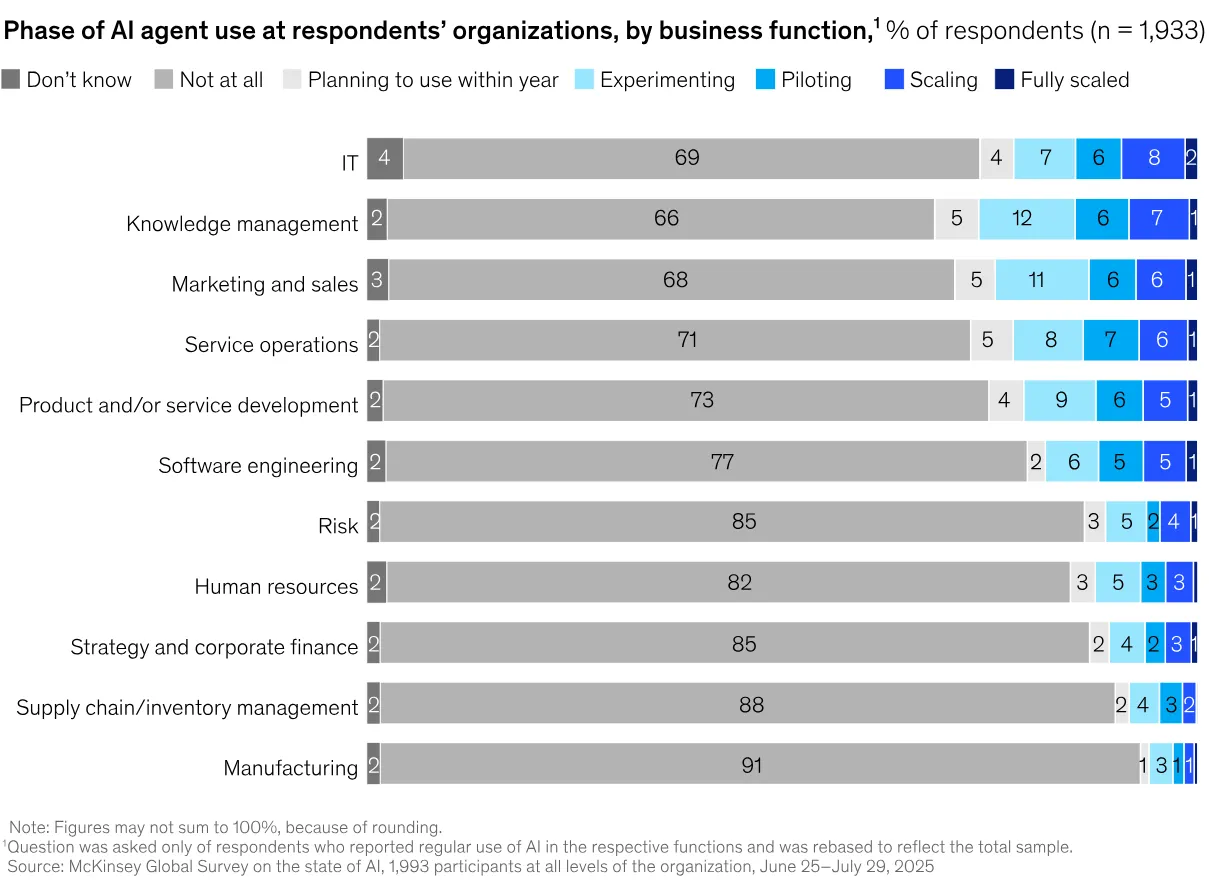
McKinsey Global "State of AI" survey statistics for agentic AI usage and scaling.
The Infrastructure Pre-requisite: People, Processes, Data (360)
Agentforce isn't the only thing selling these days though. So what's up with that Data 360 statistic mentioned earlier, and why is it relevant?
Put simply: If Agentforce is on your roadmap and your organization isn't currently part of that statistic, chances are you're not investing in the fundamentals, and falling behind the organizations that are.
Because those numbers tell you exactly where organizations are spending their energy: laying down the necessary foundations for enabling autonomous digital labor. Schema mapping. Documenting metadata. Process improvements. Identity resolution. Data quality remediation. The unglamorous work of making systems talk to each other.
This is the hidden story inside the growth numbers. Much of the reported "AI momentum" is actually infrastructure momentum. Companies are buying the pipe; they haven't turned on the water yet.

These people are probably smiling a little too much considering the fire-hazard they're currently working in.
That's not a criticism, it's a rational response to a real constraint. Autonomous agents can't function on fragmented, inconsistent data and unclear processes. The organizations investing in Data 360 are doing the necessary pre-work. But it does mean the timeline for actual agent deployment extends further than the headline metrics suggest.
None of this makes Salesforce's numbers dishonest. It makes them incomplete. The velocity is real. The depth is shallow. The infrastructure investment is significant, and necessary.
The interesting question isn't "Is Agentforce succeeding?" It's "What's preventing purchased products from becoming deployed solutions?"
Four friction points keep emerging. These are less Salesforce and Agentforce-specific failures and more predictable collision between ambitious technology and organizational reality.
1 — Process Clarity & Metadata Readiness
The conversation about "AI readiness" has fixated on data. And data matters, but it's only half the foundation. The other half, discussed far less often, is process clarity.
Agents execute processes. This means that they have to understand them, and the way they do this is by looking at your documentation. If your processes aren't documented, there's nothing to understand and no clear execution path. Or worse, if they are unclear, the illusion of clarity and trust might settle, until an Agent starts handing out sensitive data.
An autonomous agent doesn't just need to know things; it needs to know what to do with what it knows. It tries to reason this by looking at what your systems and documentation tells it. And in most organizations, those processes exist as tribal knowledge, not explicit documentation.
Here's the distinction that matters: Data tells an agent the state of the world — who the customer is, what they've purchased, whether they have an open case. Process metadata tells the agent what actions are valid, in what sequence, under what conditions. Without the second, the agent is limited to becoming just an expensive lookup.
Consider what an Agentforce agent actually needs to process a return:
- Data: Customer record, order history, product details, return policy parameters
- Process: The decision tree. Is this item returnable? Within the window? What's the condition threshold? Does this customer tier get exceptions? Who approves edge cases? What systems need updating once approved?
Most organizations have the data — scattered, perhaps, but recoverable. Far fewer have the process explicitly encoded. It lives in Sandra's head. It's "how we've always done it." New hires learn it through shadowing. It works, until you ask a machine to do it.
We'll get into trust issues later, but here is the key difference: It is okay for Sandra to execute autonomously because she is human. She has the capacity to self-govern. She intuitively understands the guardrails that an Agent needs explicitly encoded. Guardrails that end up meaning nothing without the documentation for the Agent to contextualize them.
2 — Technical Maturity & Reliability
Current AI models aren't ready for unsupervised enterprise workflows.
I'm not saying agents don't work. I'm saying they work reliably for simple tasks and unreliably for complex ones. That distinction matters enormously for deployment decisions.
Research from Carnegie Mellon found that AI agents fail to complete multi-step tasks effectively approximately 70% of the time. Single-turn interactions — "summarize this record," "find this customer's last order" — perform reasonably well. But the moment you ask an agent to execute a workflow that spans multiple systems, involves conditional logic, or requires maintaining context across a long interaction, performance degrades rapidly.
Gartner's assessment is blunt:
There are hard technical constraints compounding this. For an agent that needs to query a slow legacy ERP, wait for a response, apply business logic, and update multiple systems, the complexity of operations needed can quickly lead to timeouts and broken workflows.
Then there's the hallucination problem. Despite the Einstein Trust Layer, users report agents confidently presenting solutions that don't exist — next steps that aren't in the process, options that aren't available, information that's simply fabricated. In a demo environment, this is embarrassing. In production, with real customers, it's a trust-destroying event.
Salesforce's own future-looking reports acknowledge the rise of "workslop" — low-quality AI-generated output that employees must spend time auditing and correcting. The irony is sharp: an agent deployed to reduce workload can increase it when every output requires human verification. If you need a human to check every decision, you haven't automated the work, you've added a step.
The gap between "answer a basic question" and "execute a multi-system workflow autonomously" isn't a version upgrade. It's a capability chasm. Plan for human-in-the-loop designs. Scope deployments to tasks where 70% failure rates won't damage customer relationships. And be honest with yourself about what "autonomous" actually means today.
3 — People: Skills, Ownership, and Trust
Earlier in the article, I mentioned that we'd take a closer look at trust. The first question any organization should ask: What would I need to do to onboard an intern for this task? Would I trust them?
Autonomous agentic action requires organizational trust that most companies haven't built, and human capabilities most teams don't yet have.
Success with earlier AI- and agent-adjacent tools isn't a reliable predictor. The shift from chatbot to agent is a shift from information to action. A chatbot tells you the return policy. An agent processes the refund. That's a fundamentally different risk profile, and it requires a fundamentally different organizational posture.
55% of organizations report avoiding certain AI use cases entirely due to data privacy and security concerns. In regulated industries like financial services, healthcare and insurance, the bar is even higher. These sectors don't just prefer audit trails; they legally require them. When an agent denies a claim or approves a transaction, regulators want to know why. Exactly why. Reproducibly why.
Large language models can't provide that. They're probabilistic systems. They predict the most likely next token, not execute deterministic logic.
Interestingly, much like the large-scale cloud-migrations of the earlier decades, companies in highly regulated industries are significantly more likely to succeed at implementing Agentic AI precisely due to the strict rules they are governed by, and the preexisting process clarity driven from it.

Trust issues are compounded by skills gaps.
Only 13% of organizations report having the AI skills they need. Effective agent deployment requires capabilities that aren't yet widespread: prompt engineering, agent monitoring, exception handling design. The employees who will configure, supervise, and improve these agents often don't exist yet.
There's a darker dynamic beneath the skills gap: employees forced to audit unreliable AI outputs develop fatigue and resentment. Agents that "deflect" work from humans create displacement anxiety. Teams may passively resist adoption: bypassing agents, highlighting failures, and declining to train the systems that might replace them.
Now add the cognitive load of supervising an AI that hallucinates, and the "productivity gain" can quickly become a productivity drain.
Adding a Trust Layer
Before deployment, someone needs to answer: Who owns the agent's decisions when they go wrong? If an Agentforce agent approves a refund that violates policy, who's accountable? If it provides incorrect information that a customer acts on, who handles the fallout? In most organizations, these questions haven't been answered, because the technology arrived before the governance framework.
Trust isn't a feature you can install. It's built through demonstrated reliability over time. When an agent hallucinates a solution that doesn't exist in your process and the customer acts on it, you don't just have a service failure. You have a trust failure. Recovering from that is harder than the original deployment.
Governance isn't overhead for succeeding in a world of Digital Labor, it's a prerequisite and a small investment that protects the larger AI asset. Before deployment, answer: What's our risk tolerance for autonomous decisions? Who owns the outcome when an agent errs? What's the escalation path? What can we actually explain to a regulator? Do we have the skills to monitor and improve this? Those who don't have clear answers to this aren't ready.

Roadmapping Vision to Value:
Projects often stall due to a lack of initial process clarity, which predates the AI conversation entirely. A digital transformation initiative starts off strong and the scope looks clear: automate the quote-to-cash process, modernize the service workflow, and integrate the new acquisition.
Six months in, the project is over budget and behind schedule. Not because the technology failed but because nobody mapped (or perhaps even knew) the actual process before building started. Edge cases surface mid-development. "Oh, we also need to handle this scenario." Tribal knowledge emerges that contradicts the documented workflow. Scope creeps because scope was never truly defined, it was assumed. The discovery that should have happened in week two happens in month six, except now it's called "change requests" and it's expensive. 10x to 100x more expensive depending on how late in the project we are.
The project either balloons, gets descoped into irrelevance, or quietly dies. The technology wasn't the problem. The process clarity was never there to begin with.
AI agents rely on us feeding them this process clarity, and the most reliable way of doing that is by having good documentation that explains what is going on. This is not just limited to the process descriptions: Your Salesforce objects, fields, flows, Apex-triggers, validation rules and approval processes are all manifestations of the value stream they support. As far as the agent is concerned, this metadata is the process documentation. If your return policy lives in a PDF on SharePoint rather than encoded in Salesforce automation, the agent can't execute it. If your exception-handling process exists only as "email Joachim and he'll figure it out," the agent has no path forward.

The dimension of valuable software acutely at play here: technical debt, or sometimes more accurately named "complexity debt".
Salesforce's strength — low-code, highly flexible, low time-to-value — becomes a primary engine for technical debt. Years of 'clicks-not-code' changes under minimal governance accumulate. According to Salesforce Ben's 2025 Admin Survey, technical debt management is the most challenging task for Salesforce admins globally.
This complexity cripples an AI agent's ability to follow system-described processes. Consider a single Opportunity object: field updates might be triggered by flows built on legacy principles (One Flow to Rule Them All), a second update handled by a forgotten Process Builder, and a third managed by Apex. Three automation layers, no clear documentation, no clear sequence, no single source of truth.
An agent trying to understand "what happens when this Opportunity closes" has to parse all of that and execute its actions predictably. In a debt-laden org with ambiguous validation rules and conflicting automation, it will hallucinate, fail to execute tasks, and ultimately destroy value rather than create it. The metadata isn't just incomplete. It's contradictory.
This is the landscape. Not a technology failure, a readiness failure. The pattern repeats across industries, company sizes, and implementation maturity levels: organizations buying autonomous agent capabilities before building the foundations those agents require.
The friction points — process clarity, technical maturity, trust, and technical debt — aren't Agentforce-specific problems. They're the same obstacles that have stalled digital transformation initiatives for decades. AI just makes them impossible to ignore. You could work around undocumented processes when humans were executing them. You can't when machines are.
The diagnosis is clear enough. The harder question is what to do about it, and what it costs to do nothing.
Read next: Agentforce Readiness: Shifting Left, and The Economics of (In)Action — what being ready for AI actually means, and how "Shift Left" helps get you there.